One common misconception among DeFi users is that a wallet with extra features—transaction simulation, risk scanning, automatic network switching—automatically removes operational risk. In practice, those features change where and how risk appears rather than eliminating it. For US-based DeFi power users who move large balances across many chains, the right mental model is not “which wallet is safest” but “which wallet reduces specific, actionable attack surfaces in my workflow.” Rabby Wallet (the browser extension and companion apps) is designed to narrow certain high-impact risks common in EVM interactions; understanding how it does that, and where it still leaves gaps, is what lets a user make a disciplined trade-off between convenience and custody security.
The rest of this piece breaks down mechanisms—what Rabby does at the transaction level—compares trade-offs with typical alternatives, flags real limitations, and offers concrete operational heuristics you can apply the next time you prepare to sign a DeFi transaction from a Chromium browser in the US market.
How Rabby shifts the security calculus: mechanism-level explanation
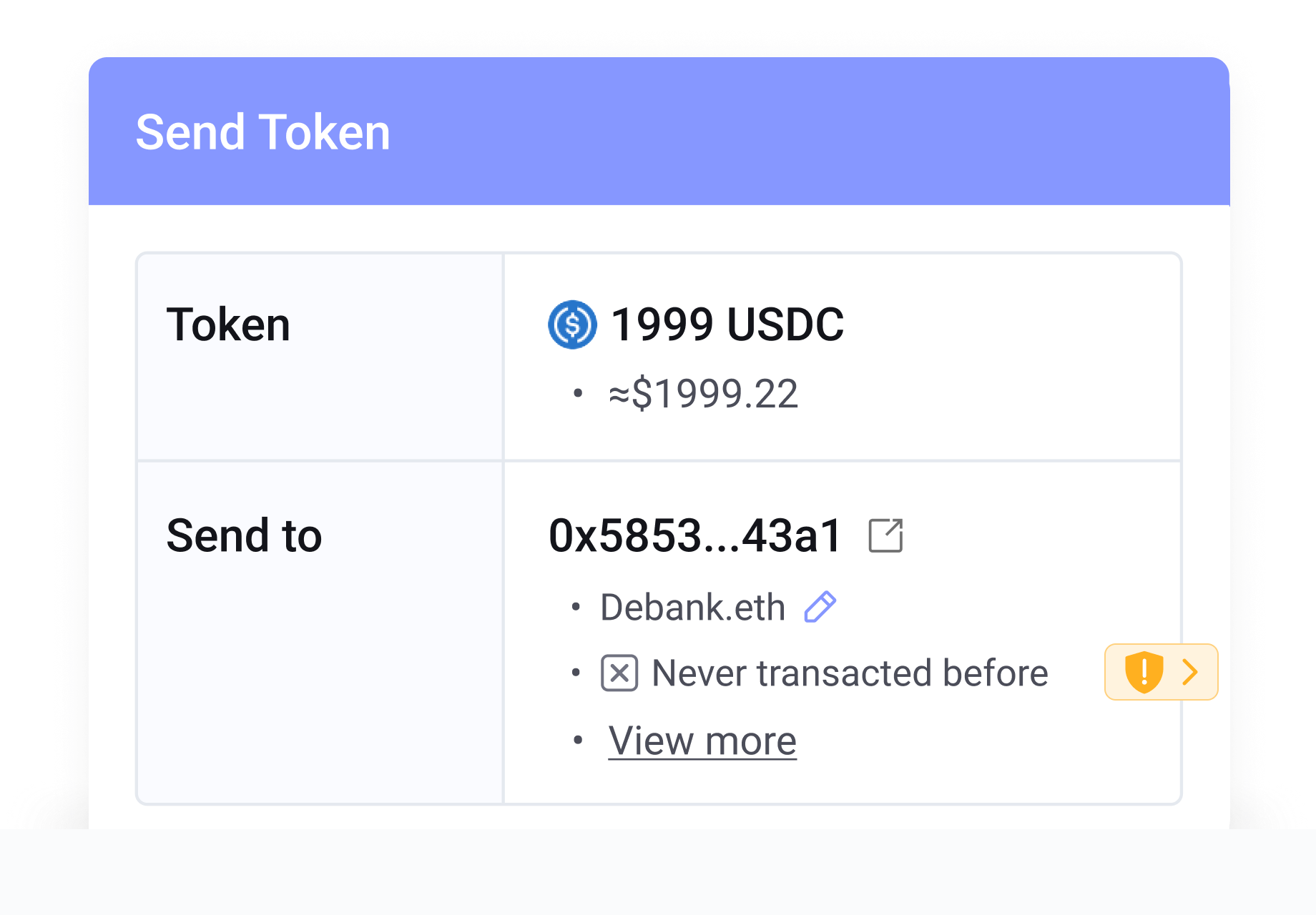
Rabby is an open-source, non-custodial wallet built by DeBank that operates primarily as a Chromium extension (Chrome, Brave, Edge) with mobile and desktop clients. Its defining mechanisms for risk reduction are transaction simulation and pre-signing risk scans. Before a transaction is signed, Rabby simulates the call locally and shows estimated token balance deltas and fee costs. That addresses the blind-signing problem: many exploits succeed because wallets present only a generic approval dialog while the smart contract executed an unexpected set of transfers or approvals.
Mechanistically, simulation works because the extension constructs an identical call and runs it against a node or an execution environment to obtain the state changes the call would produce. The user-visible output replaces an opaque “Confirm” with a three-part summary: what tokens move, who receives them, and how much the gas will cost. Rabby layers a risk engine on top of that: it flags addresses associated with prior compromises, unusually large approval requests, or non-existent recipients, and exposes active token approvals with a built-in revocation tool. These elements change the decision frame from binary signing to a short checklist: does the simulated flow match my intent; are any approvals excessive; is gas cost reasonable?
Where Rabby makes an operational difference (and where it doesn’t)
Practical difference: for users who interact with many unfamiliar dApps—DEX aggregators, new AMMs, or cross-chain bridges—the simulation plus revocation tools materially reduce the probability of signing a malicious approval or mistaken transfer. Automatic network switching eliminates the commonplace error of being on the wrong chain when a dApp attempts a call; that small UX improvement prevents failed transactions and accidental approvals on unintended networks.
Limits and gaps: Rabby does not close all attack surfaces. It is non-custodial: the extension holds keys locally (or proxies to hardware wallets), so endpoint security (browser profile compromise, extension injection, phishing sites that mimic dApps) still matters enormously. Rabby lacks an in-wallet fiat on-ramp and native staking primitives, which means US users must rely on external services for fiat-to-crypto conversion and for staking operations—introducing counterparty and operational complexity. Also recall Rabby’s past incident in 2022 where a Rabby Swap contract was exploited; the team responded responsibly, but the episode underscores that product-level security is not equivalent to ecosystem infallibility. Open-source code and audits lower risk by enabling external inspection but do not eliminate protocol-level vulnerabilities or external contract exploits.
Comparing alternatives: where Rabby stands against MetaMask, Trust, and custodial options
Compared to MetaMask and basic mobile wallets, Rabby’s unique selling propositions are the transaction simulation and pre-transaction scanning. MetaMask provides broad compatibility and market ubiquity; Rabby trades some of that ubiquity for a richer safety layer. Custodial wallets like Coinbase Wallet reduce private-key risk by managing custody but reintroduce counterparty risk and usually limit multi-chain DeFi composability. Institutional integrations (Rabby can connect to Gnosis Safe, Fireblocks, Amber, and Cobo) let power users combine Rabby’s UX with multi-sig custody practices or enterprise key-management—an important flexibility for teams or funds that need both safe signing workflows and institutional control.
Trade-offs to weigh: using Rabby with a hardware wallet (supported: Ledger, Trezor, Keystone, etc.) gives a strong combination—simulation in the UI plus private key isolation in hardware. But hardware alone does not prevent social-engineering or UI-level tricks; always confirm simulations and contract addresses on independent sources when possible. For power users, the practical choice is often a hybrid: hardware-backed local keys for high-value accounts, Rabby’s simulation for transaction clarity, and multi-sig for shared custody.
Decision heuristics for DeFi power users (a reusable framework)
Here are four simple rules—meant as operational heuristics, not absolute prescriptions—that emerge from the mechanisms above and that you can apply immediately:
1) Treat every signature as a permission, not a payment. Use Rabby’s simulation to read the permissioned flows; if the simulation shows transfers you didn’t expect, revoke and investigate.
2) Isolate high-value holdings. Keep a small “hot” wallet (hardware-backed) for interaction and a cold or multi-sig vault for long-term storage; Rabby’s integration with Gnosis Safe and enterprise providers makes that pattern easier to implement.
3) Use revocation as housekeeping. Periodically review and clear unnecessary approvals via Rabby’s built-in revocation tool; this materially reduces exposure to token-draining exploits.
4) Assume the UI is necessary but insufficient. Simulations are powerful, but cross-check critical addresses and contract sources externally, especially for large or irreversible transactions.
Where to watch next: conditional scenarios and signals
If Rabby continues to expand audits and formal verification around its simulation engine and integrates a native fiat on-ramp or staking modules, it would close usability gaps that currently force users to juggle external services—reducing surface area for human error. Conversely, the most important signals to monitor are not marketing numbers but technical telemetry: are there new third-party audit reports; has the team disclosed responsible-disclosure outcomes promptly; and are integrations with institutional custody providers expanding? Each of these signals changes the conditional confidence you can place in Rabby for higher-value operational roles.
Another conditional scenario: broader adoption of transaction simulation as a UI standard would shift the baseline of expected wallet behavior. If major wallets adopt similar simulation displays and revocation flows, the security advantage narrows; the useful comparison for a power user then becomes integration quality (hardware support, multi-sig) and the accuracy/latency of simulations across congested chains.
FAQ
Does Rabby prevent phishing and browser-level malware?
No—Rabby reduces certain signing risks but cannot stop endpoint compromises or sophisticated phishing that tricks users into signing malicious transactions. Use hardware wallets, keep browser profiles segregated, and verify URLs and contract sources externally.
Can Rabby replace a hardware wallet or a multi-sig for institutional funds?
Rabby complements but does not replace hardware devices or multi-sig solutions for institutional custody. It integrates with Gnosis Safe and enterprise providers, which is the recommended approach for high-value or shared custody scenarios.
How reliable are Rabby’s transaction simulations across 90+ EVM chains?
Simulations depend on accurate node state and deterministic execution models. On widely used chains (Ethereum, BNB, Arbitrum), simulations are generally reliable; on newer or lightly indexed chains the fidelity may vary. Treat simulation outputs as high-quality guidance, not absolute proofs.
Is Rabby’s code auditable and can I run it locally?
Yes. Rabby is open-source under the MIT license, which allows audits and local inspection. That transparency raises confidence but requires technical review to verify specific claims or custom deployments.
For DeFi power users in the US considering an operational upgrade in wallet security, Rabby is worth testing because it makes several previously manual checks explicit and machine-verifiable—particularly simulation and revocation. But treating those additions as risk-eliminating rather than risk-managing will be a mistake. The practical improvement comes when Rabby’s features are folded into a disciplined routine: hardware-backed keys, periodic revocation, multi-sig for vaults, and external verification for critical contracts. If you want to explore Rabby’s feature set and install options, see this resource on rabby wallet.